

Master Long-Term Investment Analysis Workflow for Real Estate

Staying ahead in real estate investment demands more than intuition—it requires a robust workflow built on reliable analysis and quality data. With specialized investment analysis tools now offering automated calculations, data centralization, and customizable modeling, experienced investors can eliminate guesswork and cut unnecessary consulting costs. By adopting platforms designed for both scalability and precision, you set the foundation for informed, confident decisions as your portfolio grows from local markets to global opportunities.
Table of Contents
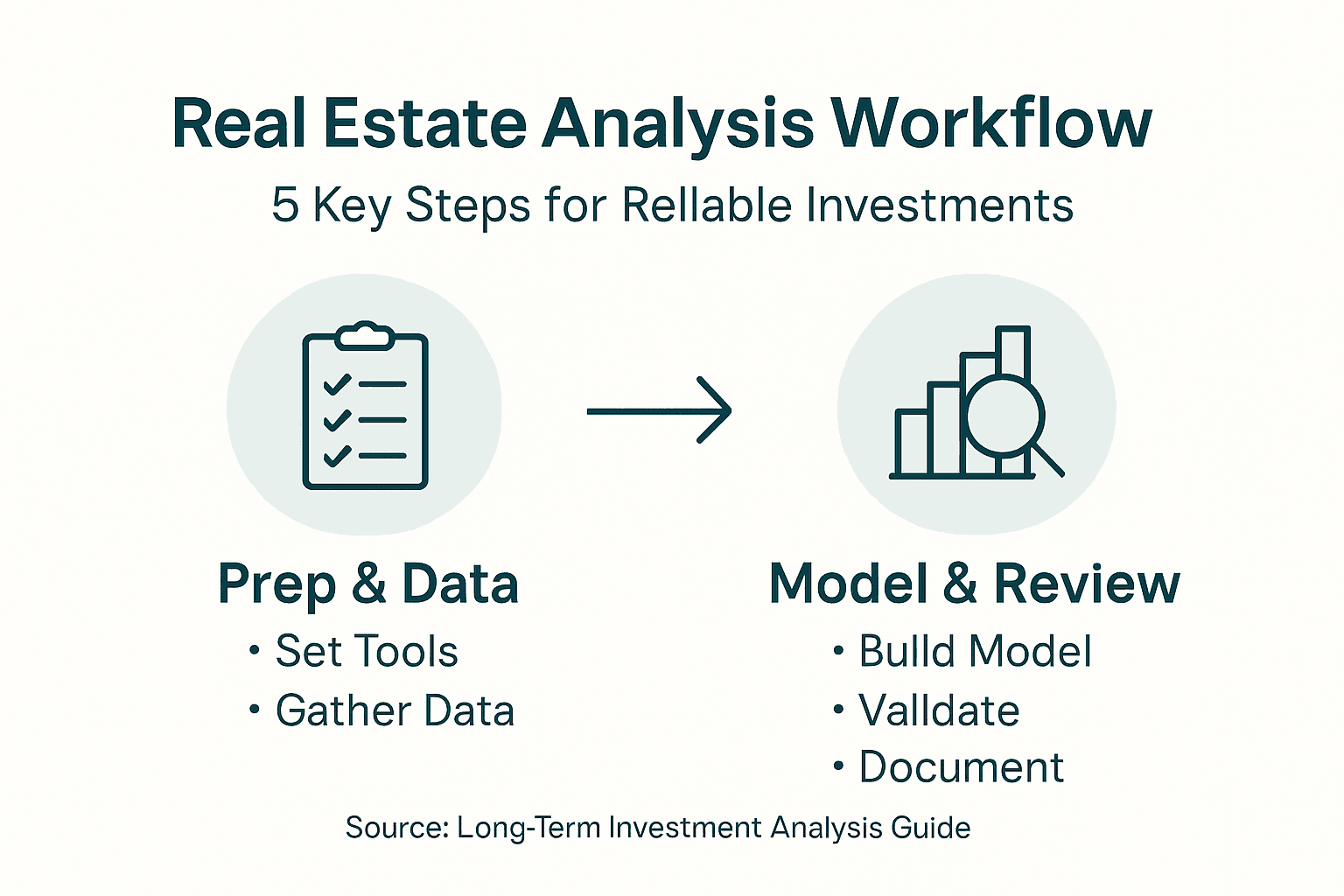
- Step 1: Set Up Reliable Financial Analysis Tools
- Step 2: Gather Accurate Investment Data and Inputs
- Step 3: Build Robust Cash Flow and Scenario Models
- Step 4: Validate Results with Quality Checks
- Step 5: Document Workflow for Consistent Decision-Making
Quick Summary
Essential Insight | Clarification
1. Choose Quality Financial Tools
Select platforms that integrate data management and calculations for accurate real estate analysis. Opt for tools suited for your investment strategies.
2. Collect Reliable Data Inputs
Ensure you gather comprehensive, verified data categories to support your financial analyses. Inaccurate inputs can lead to misleading projections.
3. Build Effective Cash Flow Models
Create transparent models that illustrate cash inflows and outflows clearly. Include various scenarios to assess risk and returns effectively.
4. Validate Analysis Thoroughly
Regularly cross-check your model’s calculations and assumptions. Implement quality checks to prevent costly investment mistakes.
5. Document Your Processes
Establish a systematic approach for recording methodologies and assumptions in your analyses. This improves consistency and decision-making over time.
Step 1: Set Up Reliable Financial Analysis Tools
Setting up the right financial analysis tools is foundational to your long-term real estate investment success. You need platforms that handle complex calculations, organize your data efficiently, and generate reports you can actually trust when making million-dollar decisions.
Start by choosing tools that combine data management with calculation power. The best real estate investment analysis tools should handle both property acquisition and ongoing financial modeling without forcing you to switch between multiple platforms.
Core capabilities to prioritize:
- Automated cash flow projections across multiple time horizons
- Customizable financial models that adapt to your specific investment strategy
- Integration with spreadsheet platforms you already know (Excel or Google Sheets)
- Clear visibility into how calculations work, not black-box formulas you can't audit
When evaluating options, look for platforms that let you centralize financial data from multiple properties. This prevents the common mistake of analyzing each deal in isolation, which masks portfolio-level risks and opportunities.
Many investors make the error of choosing tools based on flashy interfaces rather than analytical depth. The platform should automate financial calculations while keeping you in control of your assumptions and logic. You're building a decision-making system, not just running quick numbers.
Consider whether the tool supports your specific investment strategy. Long-term rentals require different modeling approaches than fix-and-flip projects. A rigid tool that doesn't accommodate your methodology creates friction and inaccuracy.
Data accuracy matters more than speed. A tool that takes you five minutes to input assumptions but generates unreliable projections costs you more than a thorough system requiring fifteen minutes of work.
Start with tools designed for serious investors. Your analysis quality directly impacts capital allocation decisions worth hundreds of thousands of dollars.
Once you've selected your primary platform, set up standardized input templates. Consistent formatting across all your deals makes it easier to identify patterns, compare opportunities fairly, and spot calculation errors before they influence your decisions.
Pro tip: Test your chosen tools with a property you already own before analyzing new deals. This reveals whether the platform actually matches how you think about investment decisions and helps you catch any calculation discrepancies early.
Here's how core financial analysis tools differ in their practical impact:
| Tool Type | Key Benefit | Common Pitfall |
|---|---|---|
| Integrated Platforms | Unified data and modeling | Can be complex to set up |
| Spreadsheet Templates | Customizable calculations | Error-prone without controls |
| Standalone Calculators | Quick answers for simple cases | Lack portfolio view |
| Data Aggregators | Fast access to market stats | May lack model flexibility |
Step 2: Gather Accurate Investment Data and Inputs
Accurate data is the backbone of reliable financial analysis. Without quality inputs, even the most sophisticated models will produce misleading projections that lead you to wrong decisions about capital allocation.
Start by identifying the specific data categories your analysis requires. Property characteristics, market conditions, financing terms, and operating expenses all feed into your investment model. Missing or inaccurate information in any category undermines your entire analysis.
Essential data inputs to collect:
- Property specifications (square footage, unit count, age, condition, systems)
- Historical performance data (actual rents, vacancy rates, maintenance costs)
- Market comparables (similar property sales, rental rates in the area)
- Local market trends (appreciation rates, demographic shifts, economic indicators)
- Financing details (loan terms, interest rates, prepayment penalties)
- Operating expenses (property taxes, insurance, utilities, management fees)
When gathering market data, use standardized real estate investment data sources that follow consistent reporting frameworks. This ensures comparability across different properties and markets, preventing the common mistake of mixing data collected using different methodologies.
Verify your data through multiple sources. Rely on public records, local assessor databases, and comparable property transactions rather than single sources. Cross-referencing catches data errors that could skew your projections by thousands of dollars monthly.
Be especially careful with expense assumptions. Many investors underestimate maintenance costs, capital reserves, and vacancy impacts. Historical data from similar properties in your market provides more realistic figures than generic rules of thumb.
Quality data beats sophisticated formulas every time. A simple model built on verified inputs outperforms complex analysis based on guesses and assumptions.
Documentation matters as much as accuracy. Record where each data point came from and when you collected it. This creates an audit trail and helps you identify which assumptions changed between analysis cycles.
Pro tip: Build a standardized data collection spreadsheet for each property type you analyze, then reuse it for every deal. This reduces data entry errors and makes it easier to spot when new information contradicts your baseline assumptions.
Step 3: Build Robust Cash Flow and Scenario Models
Building a solid cash flow model transforms raw data into actionable insights. Your model becomes the lens through which you evaluate whether a property will generate the returns you need over your investment timeline.

Start by structuring your model to capture three core components: income, operating expenses, and financing costs. Each component feeds into cash flow calculations that show you exactly when money enters and leaves the property throughout your holding period.
Key model components to include:
- Rental income with realistic vacancy assumptions
- Operating expenses broken into fixed and variable categories
- Capital expenditure reserves for major system replacements
- Debt service payments and principal paydown
- Cash flow surplus or deficit for each period
- Cumulative returns and performance metrics
When structuring your model, make formulas transparent and auditable. Anyone reviewing your analysis should be able to trace each calculation back to its underlying assumptions. Black-box models hide errors and make it impossible to identify which assumption drives your conclusions.
Real estate financial modeling requires testing your base case assumptions against alternative scenarios. Build at least three scenarios: conservative (lower rents, higher expenses), base case (realistic expectations), and optimistic (strong performance). This reveals which variables most significantly impact your returns.
Scenario analysis exposes your biggest risks. If your investment only works in the optimistic scenario, you're taking on more risk than you realize. If returns stay positive even under conservative assumptions, you have genuine margin for safety.
Test your assumptions, not just your numbers. The scenarios that challenge your base case reveal where market shifts could derail your investment thesis.
Create dynamic models that update automatically when you change inputs. Manual recalculation introduces errors and discourages thorough sensitivity testing. Proper model structure lets you ask "what if" questions quickly and confidently.
Document your model logic and assumptions clearly. Future you will appreciate knowing why you made specific decisions about interest rate assumptions, expense growth rates, or holding periods.
Pro tip: Build your initial model with only essential variables, then add complexity once the core logic works perfectly. A simple, accurate model beats a complex model full of mistakes. Start with five-year projections before extending to longer timelines.
Below is a quick reference for scenario modeling approaches:
| Scenario Type | Main Focus | Strategic Value |
|---|---|---|
| Conservative | Stress test for downside risk | Identifies breaking points |
| Base Case | Most likely outcomes | Sets realistic expectations |
| Optimistic | Upside potential | Highlights best opportunities |
Step 4: Validate Results with Quality Checks
Validation separates confident decisions from costly mistakes. Before you act on your analysis, systematic quality checks catch errors that could skew projections and lead you toward bad investments.
Start by verifying that your model calculations actually match your underlying assumptions. Run a few key numbers manually to confirm the formulas work correctly. This catches logic errors that spreadsheet software won't flag.
Critical validation checkpoints:
- Verify cash flow totals match income minus expenses minus debt service
- Check that input assumptions haven't accidentally been overwritten or changed
- Confirm all formulas reference the correct cells and ranges
- Test edge cases to ensure calculations handle unusual scenarios properly
- Cross-check key metrics against industry benchmarks for similar properties
- Review whether historical data you used matches the property's actual performance
Implement real estate data validation practices by verifying data completeness and consistency. Missing data points, duplicate entries, or mismatched units introduce errors that compound through your projections. Clean data is accurate data.
Test your model with known scenarios. If you're analyzing a property with published performance history, run those actual numbers through your model. Does it recreate the real results? If not, your assumptions are off.
Compare your calculated returns against comparable properties in the market. If your analysis shows 12 percent returns while similar properties in the area achieve 6 percent, dig deeper. Are your assumptions unrealistically optimistic, or have you identified a genuine opportunity?
Validation isn't a final step, it's ongoing insurance. Run checks whenever you change assumptions, before you present analysis to partners, and before you commit capital.
Document every adjustment you make during validation. Explain why you changed an assumption and what impact it had on your projected returns. This creates accountability and helps you learn from each analysis.
Involve someone else in reviewing your work when possible. Fresh eyes catch mistakes you've overlooked after staring at spreadsheets for hours. Outside perspective challenges weak assumptions you've stopped questioning.
Pro tip: Create a checklist of validation steps and run through it before finalizing any investment analysis. Include verification of formulas, comparison against benchmarks, documentation of assumptions, and a final reasonableness test. Consistency across all deals prevents missed errors.
Step 5: Document Workflow for Consistent Decision-Making
Documentation transforms analysis from a one-time event into a repeatable system. When you record how you evaluated properties, which assumptions you tested, and why you reached specific conclusions, you create a decision-making framework that improves with every deal.
Start by documenting your analysis methodology before you begin any evaluation. Record the specific steps you follow, the tools you use, the assumptions you make, and the decision criteria you apply. This becomes your template for all future deals.
Essential documentation includes:
- Property description and key characteristics
- Data sources for each input (where did this number come from?)
- Assumptions about rent growth, expense escalation, and vacancy rates
- Scenario parameters (conservative, base, optimistic cases)
- Key findings and decision drivers
- Final recommendation and reasoning
- Date analysis was completed and by whom
Use centralized document management systems to organize all supporting materials in one searchable location. Property appraisals, lease agreements, market studies, and financial projections should live together, making it easy to revisit past decisions or find information quickly.
Create standardized templates for each property type you analyze. A rental duplex requires different documentation than a commercial office building, but using consistent formats across similar deals makes pattern recognition easier and reduces errors.
Time-stamp your analysis versions. When you adjust assumptions mid-process, save the previous version with clear notes on what changed and why. This audit trail shows your thinking evolution and helps you learn from past decisions.
Your documented workflow is your competitive advantage. It captures what works, prevents repeating mistakes, and lets you scale decisions efficiently across multiple properties.
Include a summary section highlighting the analysis's confidence level. Are you 95 percent confident in your rent assumptions because they're based on recent comparable leases? Or only 60 percent confident because market data is limited? Honest confidence assessments prevent overcommitting to weak projections.
Review past analyses quarterly to identify patterns. Did your assumptions prove accurate? Which variables consistently surprise you? Learning from documented history dramatically improves future accuracy.
Pro tip: Create a master checklist of documentation requirements and attach it to every analysis you complete. Include verification that all assumptions are sourced, all formulas are audited, and all decisions are justified. This ensures consistency even when you analyze deals under time pressure.
Elevate Your Long-Term Real Estate Investment Analysis with Professional Tools
Mastering the complex workflow of long-term real estate investment analysis demands precision, clarity, and reliable automation to avoid costly errors. This article highlights critical challenges investors face such as setting up transparent financial models, gathering accurate data inputs, and validating results to confidently allocate capital. If you want to transform raw data into informed decisions while streamlining your workflow consider exploring Smart Real Estate Investment Tools – Analyze Properties & Deals for robust, customizable solutions designed for serious investors.

Empower your investment analysis process by integrating industry-leading spreadsheets and calculators tailored to real estate professionals. These tools provide automated cash flow projections, scenario testing, and clear documentation features that mirror the article’s recommended best practices. Start building model consistency and confidence today with resources from Professional Real Estate Analysis Excel Systems | MIRR & ROI Tools. Visit Whereisthemoney.shop now to access institutional-grade financial tools that take your analysis from theory to actionable insight. Don’t wait to bring accuracy and transparency to your capital allocation decisions.
Frequently Asked Questions
How do I set up reliable financial analysis tools for real estate investments?
Start by selecting tools that integrate data management and financial calculations. Focus on platforms that automate cash flow projections and allow for customizable financial models to align with your investment strategy.
What data should I gather for long-term investment analysis in real estate?
Collect key data categories such as property specifications, historical performance, market comparables, and financing details. Ensure that you verify this information through multiple reputable sources to maintain accuracy in your projections.
How can I build robust cash flow and scenario models for real estate investments?
Structure your cash flow model to include rental income, operating expenses, and financing costs. Test different scenarios—conservative, base case, and optimistic—to understand potential risks and returns based on varying assumptions.
What are effective validation checks for real estate financial models?
Implement quality checks such as verifying that cash flow totals match income and expenses and confirming that all formulas reference the correct cells. Conduct a test with known scenarios to ensure your model accurately reflects actual performance before making investment decisions.
Why is documenting my investment analysis workflow important?
Documentation creates a repeatable system that improves decision-making over time. Record your methodology, assumptions, and findings for each analysis, which allows you to learn from past decisions and maintain consistency in your approach.
Recommended
- Step-by-Step Real Estate Investment Analysis (Pro Tips) – WHERE IS THE MONEY
- Real Estate Profitability Calculator – Compare Up to 5 Deals – WHERE IS THE MONEY
- How to Analyze Real Estate Investments Like a Pro – WHERE IS THE MONEY
- Smart Real Estate Investment Tools – Analyze Properties & Deals – WHERE IS THE MONEY